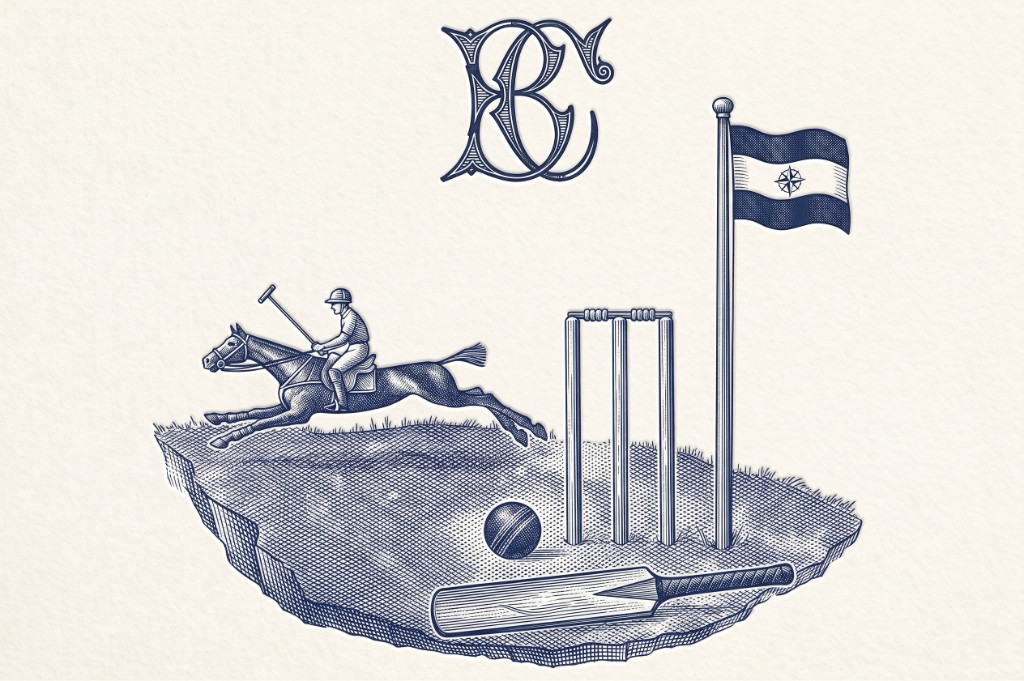
The club took its name from Bullingdon Green, a cricket ground on the common south-east of the city, between Horspath and Cowley. The green itself was named for the Bullingdon Hundred, the old subdivision of Oxfordshire in which it lay. Undergraduates rode out there to play. In 1795 the club met Marylebone Cricket Club on that ground, and lost.
For a long time the match and the meal were the same outing. Men rode across Cowley Common, played in the middle, raced horses round the game, and dined when the cricket was done. It was already expensive, and already closed. Writing of 1805, G. V. Cox remembered that cricket at Oxford was kept up chiefly by men from Winchester and Eton, and was confined to the old Bullingdon Club.
The ground did not survive the club. In 1876 Cowley Barracks were built over Bullingdon Green, and the cricket had to move. By then the dinner had become the point. A report of that year said cricket there was secondary to the dinners, and that the men were chiefly of an expensive class. In 1913 the New York Times called the Bullingdon the acme of exclusiveness at Oxford, the club of the sons of nobility and of great wealth.
Membership has remained small, and by invitation. For the annual dinner, members wear a bespoke navy tailcoat with ivory silk facings, a mustard waistcoat and a sky-blue bow tie. Sky blue and ivory are the club's colours. The old sporting device, a rider with the kit of a cricketer, is still its emblem. A trace of the racing survives in an annual point-to-point, where the members take a champagne breakfast and the club's president, the General, presents the cup.
It is not a society of the University, though its members are. The proctors have suspended it more than once, including in 1927 and 1956, for the disorder of its evenings. John Betjeman wrote in 1938 that quite often the club was suspended for some years after each meeting. The habit of smashing what had been hired, and paying for it before the night was over, is an old one. In 1894 members broke hundreds of windows in Peckwater Quad at Christ Church, and the quad was wrecked again in 1927. Edward VIII, while Prince of Wales, was allowed to join only if he kept clear of a "Bullingdon blind". After he attended one, Queen Mary asked him to take his name off the list.
Former members include Edward VII and Edward VIII, the Earl of Rosebery, and, from a later generation, David Cameron, Boris Johnson and George Osborne. A photograph of the 1987 group, Johnson and Cameron among them, became one of the familiar pictures of modern British politics. Johnson afterwards called his membership a shameful vignette of undergraduate arrogance. Evelyn Waugh turned the club into the Bollinger in Decline and Fall, and named it in Brideshead Revisited. Laura Wade's play Posh, and the film The Riot Club, took the same dinners as their model.
What remains is a private dining club for men at Oxford. Most of the cricket is gone. The reputation is not.